Garage Door Installation in {{area.main}}
A new garage door is measured to your opening and fitted with springs matched to its weight and tracks set for your ceiling, once the old door has come down.
Whether the old door on your home in the {{area.alt}} was hit by a car, has rotted out, or simply looks tired, the choice comes down to material, insulation, style and how the garage is used. This page walks through those choices so you can compare quotes properly.
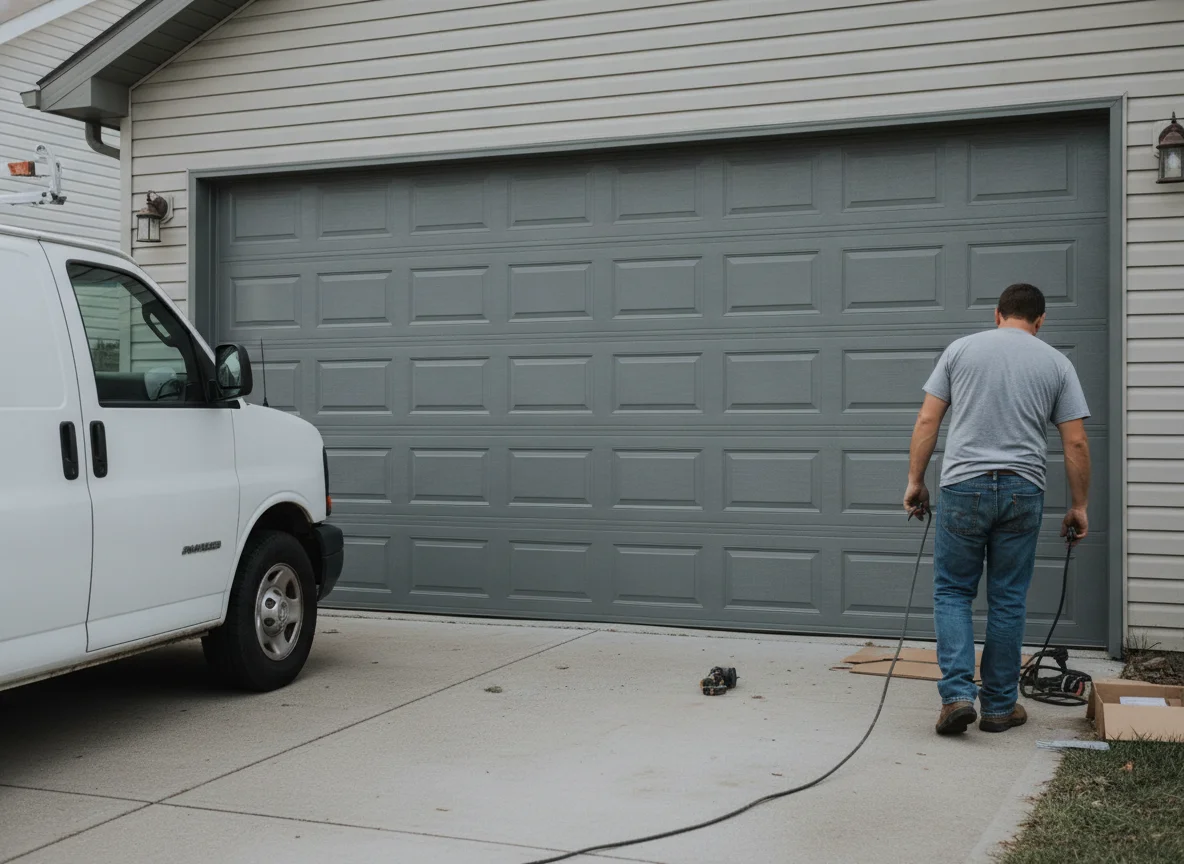
New door, or a new section?
Not every damaged door needs replacing. If one or two sections are dented, cracked or rotted and the rest are sound, a replacement section may do, provided the manufacturer still makes a matching one for your door. Older doors often can't be matched, and a new section beside faded old ones can look patched.
A whole new door usually makes sense when:
several sections are damaged, or the door has bent out of shape;
a wooden door has rot in more than one place;
no matching sections are made any longer;
the garage is attached and the old door is uninsulated and drafty;
you want a different look, windows, or a quieter door.
If the door is sound and the trouble is with how it moves, the fix is probably a spring, cable or opener repair instead.
Thinking about a new door? Send the width and height of the opening and a photo of the garage.
Contact UsChoosing a door
Material
Steel
The most common choice: durable, low maintenance, and available in single-layer, double-layer and insulated sandwich construction. Thicker gauge dents less.
Wood
Handsome and heavy. It needs refinishing to keep weather out, and it needs heavier springs and a stronger opener.
Composite and wood-look steel
The appearance of wood with far less upkeep.
Aluminum and glass
Modern and full of light, but less private and less insulating unless the glass is insulated.
Fiberglass
Resists dents and salt air. It can fade or turn brittle in hard cold.
Insulation
Insulation matters most on an attached garage, a garage with a room above it, or one used as a workshop. Insulated doors are rated by R-value: the higher the number, the better it holds heat.
They're also stiffer and quieter, which is a reason to choose one even for a detached garage. If the garage is unheated and separate from the house, a non-insulated door is often enough.
Style and windows
Raised-panel, flat, carriage-house and modern flush designs are all made in most materials. Windows can run along the top section or not at all. The door is often the largest single thing on the front of a house, so it's worth holding samples up against the siding before deciding.
Where the rules apply
Some areas require doors rated for wind load, and some neighborhoods have covenants on color or style. Ask whether either applies to your address before choosing.
What gets measured
A door is ordered to fit, so the measurements come before the price:
Width and height of the opening.
Headroom
The space between the top of the opening and the ceiling, which decides the kind of track and springs that will fit.
Backroom
The depth from the door into the garage, for the horizontal track and the opener.
Side room on each side of the opening for the vertical track.
A low ceiling, a beam in the way or a very narrow side wall doesn't rule out a new door, but it changes which hardware is used.
What happens on installation day
The old door comes down
Spring tension is released first, then sections, track and hardware are removed.
The opening is checked
Rotted jambs or a crumbling header are better found now than after the new door is up.
New track and springs go in, sized for the new door rather than reused from the old one.
Sections are stacked and hinged, rollers set, cables fitted, and the springs wound or set for the door's weight.
The opener is reconnected or replaced, its force and travel set for the new door, and the safety reversal tested.
The old door and packaging are hauled away, if that's part of the quote.
Tell us what the door is doing
A sentence or two is plenty to start. You don't need to know the name of the part that's failed.
What drives the cost of a new garage door
Size
Single, double, or an oversized opening.
Material and construction
Single-layer steel versus insulated steel, wood or glass.
Insulation level
Windows and decorative hardware
Track and spring hardware, especially where low headroom needs special track.
Repairs to the opening
Jambs, header or bottom seal.
Removal and disposal of the old door.
A new opener, if the old one is worn or unsuited to a heavier door.
What to ask before you choose a quote
Is removal and disposal of the old door included?
Are new springs, cables and track included, or is the old hardware being reused?
Are the springs matched to the new door's weight?
What warranty does the door manufacturer give, and what covers the installation itself?
Will the existing opener work with the new door, and does it have modern safety reversing?
Two quotes that look far apart are often quoting different doors or different hardware. Line them up on those questions before comparing the totals.
Common questions
Can I reuse my old springs and tracks?
It's rarely a good idea. Springs are sized to one door's weight, and a new door almost never weighs the same as the old one. Worn track makes a new door run badly from day one.
Do I need an insulated door?
If the garage is attached, has a room above it, or is somewhere you spend time, usually yes. For a detached, unheated garage it's a matter of noise and stiffness more than heat.
Can a new door be fitted to an old opener?
Often, if the opener is strong enough for the new door's weight and has working safety reversing. A much heavier door, such as solid wood, may need a stronger unit.
Other garage door services
Garage Door Opener Repair
Openers that hum, reverse or won't respond, and new openers when repair isn't worth it.
Read more →Garage Door Spring Repair
Broken torsion or extension springs replaced with springs matched to your door's weight.
Read more →Garage Door Maintenance
A tune-up that checks springs, cables, rollers and safety reversal before anything fails.
Read more →Get in touch
Send the width and height of the opening if you have them, whether the garage is attached, and what you'd like the new door to be: a match for the old one, or something different.
Photos of the outside of the door and of the ceiling space above it help with the first conversation.